For architects

Read us your plans.

Not send — read. Walk us through a set you're drawing, ask whatever automation questions come up, and we'll tell you what usually gets missed. It's free, there's nothing to buy, and whatever's useful goes back into your drawing.

Why we're offering it

You are not the problem. You asked, and nobody answered.

Most architects do ask. You ask the homeowner what they want to do about shades and the homeowner says "I don't know." You never get an answer, you have to work forward, and you frame a normal window.

They are not being difficult. They cannot picture it — it is two years away and nobody has ever shown them what the choice actually is. So the default wins by silence: a shade in a box, above the window, in the room, in the sightline, for the life of the house.

Nobody is doing this part for you. The low-voltage trade shows up after the drawings are done, sells what it sells and leaves. By then the decisions that were free are change orders, and the ones that were change orders are impossible. We would rather answer the questions while they still cost nobody anything — and we would rather do it without a contractor in the room trying to sell you something.

How it works

Twenty minutes, your drawings, our questions.

The kind of thing that comes up · one

Nine or ten inches, and the shade is gone.

A window header is normally two or three load-bearing 2x12s. Drawn in from the start, a small cut-in I-beam frees the nine or ten inches a pocket needs — and the shade lives inside the structure where nobody ever sees it. A removable wood panel gets it back for service.

Why nine or ten and not four: documented pockets run four to seven and a half inches, but roll-up diameter depends on the cloth, and the cloth is not chosen yet. Asking big absorbs a larger tube, a fabric that will not curl tight, and the clearance to get the thing back out.

Free on paper. Expensive at framing. Impossible after drywall.
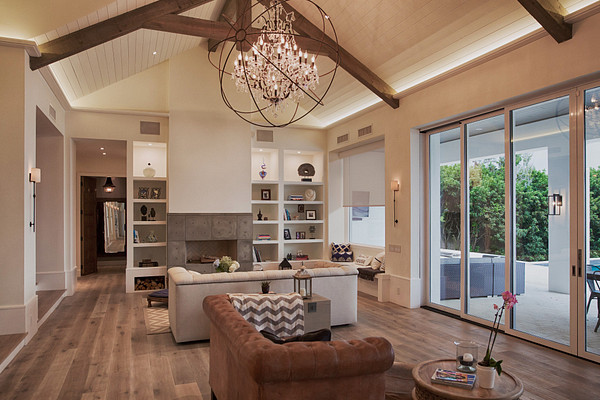
A living room where the shade sits concealed in a pocket above the window, invisible in the finished room.
Look above the slider on the right: that white band is a fascia, and it is the good version of not having a pocket. A pocket is the one you cannot find at all.

The kind of thing that comes up · two

There is a 300 lb load in the building nobody has mentioned.

An arched window, in a bedroom, for someone who sleeps in total darkness. A blackout shade cannot run to the top of an arch. The documented solution is a cable-guided roller shade — and the installation requires that the upper and lower cable anchors each withstand up to 300 lb (135 kg).

That is structural blocking, top and bottom. It cannot be added to finished drywall. It is not a preference, a finish or a change order — it is a load rating in a building, for a component nobody told you was coming.

Arches and great rooms are where this bites. Most windows are ordinary and need nothing from you at all. We will tell you which is which, off the drawings, before it costs anybody anything.

The kind of thing that comes up · three

The equipment needs a room, and it was never drawn.

On the last eight-million-dollar house we worked on, nobody drew a room for the equipment. It ended up split across three separate closets that were supposed to be closets.

It is a small ask and it is almost always missed. Put it near the middle of the house — everything home-runs back to this one location, so a room at one end is materially more wire. Give it its own room, not shared: we have been put next to radiant manifolds, and a burst line above a rack destroys the most expensive equipment in the building.

And it needs depth, not just width. A rack is two feet wide and two feet deep, but it rolls forward to be serviced. That is why an equipment closet sized to the rack itself stops working the day somebody has to get behind it.

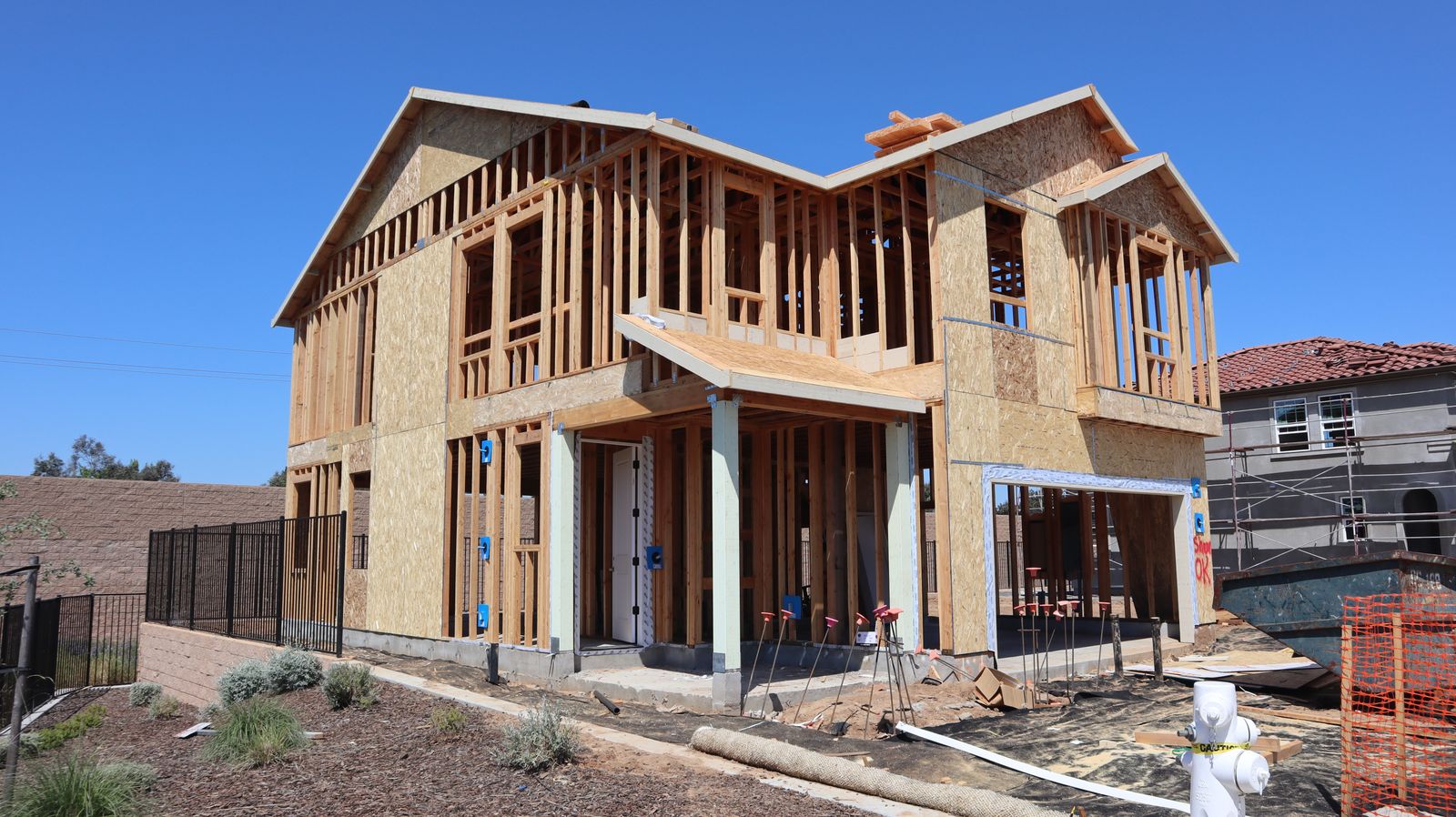
A two-storey house under construction, still open framing, before sheathing and drywall.
This is the last week any of it is free. After this it is a change order, and after drywall it is not possible at all.

What that means on a drawing

~7 ft deep The room, not the rack. Twenty-four inches of equipment plus the clearance to roll it out and get behind it. An ordinary house is one rack.
~1,200 BTU/hr Rejected into that room, continuously, by an ordinary house. The largest house we ever built ran about 4,250 across two racks. That figure is for your mechanical contractor — a louvered door does not remove heat from a room.
Zero Space and heat from the lighting and shade panels. They live with the electrical panels, anywhere convenient, and they run cold. All they need from you is a communications pathway back.

On the drawing

Two lines, and we stay out of your way after that.

And then we stop. The access panel is sized a little larger than the brackets and has to clear the shade to come out — six inches or nine reads the same from the room. The reveal, and how the frame meets plywood and drywall, is your problem and not ours. You will detail it better than we would, and we don't want credit for it.

The ask

Read us your plans.

Don't send the whole set — pick twenty minutes and walk us through it. You talk, we ask, and you get the answers in writing, in time for it to cost nobody anything. We call you, so all you need is the drawings in front of you.

And use it with your client. The reason this decision never gets made is that nobody ever puts it in front of the homeowner. Show them what the choice is and they can finally make it — which is all any of us needed.

Pick a time Twenty minutes, free, nothing to buy. Or email vince@smarthometheaters.com if that's easier.
We do not sell shades, fabric or motors. We specify them, and we supply and run the control.
Our whole reason for beingAnd we do not leave.

The house you drew still works in ten years. Most people in this trade finish and move on — in twenty-five years we have never left one. We have only ever lost a client to a move or a death, and in several of those houses we still look after the system for whoever lives there now.

And the software that looks after it afterwards is ours too. Ixome programs, updates and watches Control4 systems remotely — no truck, no trip charge. It is where the technical detail lives.

Go to Ixome.ai